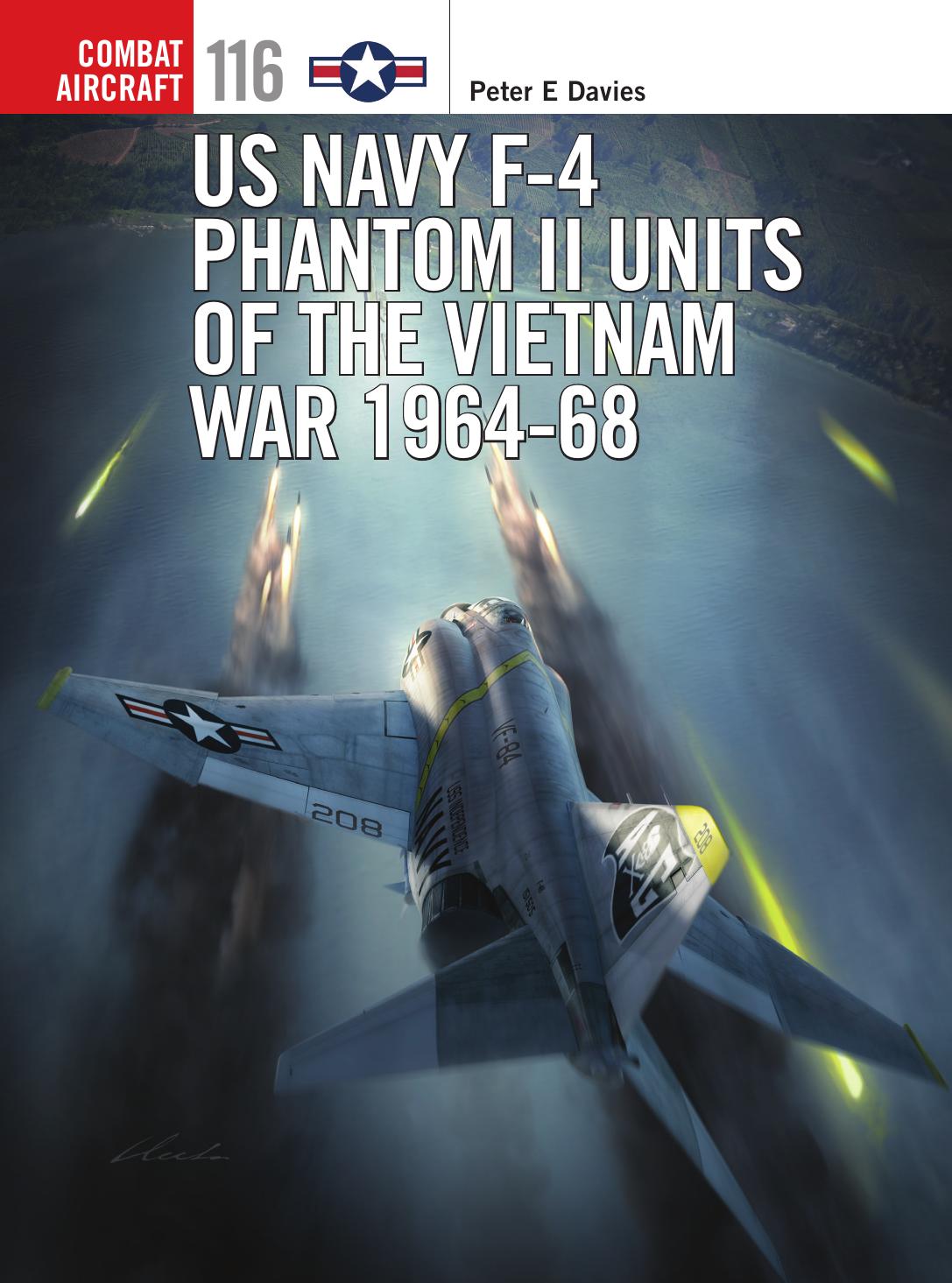
US Navy F-4 Phantom II Units of the Vietnam War 1964-68 by Peter E. Davies
Author:Peter E. Davies
Language: eng
Format: epub, pdf
ISBN: 9781472814531
Publisher: Bloomsbury Publishing
Published: 2016-04-11T04:00:00+00:00
F-4B BuNo 152255 from VF-114 was lost on 26 April 1966 after dropping Mk 82 bombs on weapons-carrying junks near Vinh. Although Lt(jg)s W W Smith and R Blake managed to return to Kitty Hawk, damage to the hydraulics meant that they could not lower the flaps or undercarriage and they had to eject. The damage was probably caused by pieces of debris from the exploding boats or by bomb shrapnel. Their squadron had also devised its own bombsights and delivery tactics using Skyraider sights scavenged from the US Navy storage facility at Litchfield Park, in Arizona. They replaced the existing Westinghouse sights, while squadron members Dave Coker and Fritz Klumpp worked out settings for dropping bombs at various dive angles and altitudes.
FOOLING SAMs
The threat posed by SA-2 ‘Guideline’ SAMs required an urgent response before it made losses in Rolling Thunder unsustainable. The weapon had been used to shoot down a CIA Lockheed U-2C reconnaissance aircraft over Russia in May 1960, causing a major international incident. A U-2F was destroyed over Cuba in October 1962 during the Cuban Missile Crisis and this almost resulted in 500 US bombing sorties being directed at the 144 SA-2 launchers that had been installed in Cuba with Soviet operators.
The Pentagon was understandably alarmed at the prospect of numerous SA-2s being placed in the comparatively small North Vietnamese target area around Hanoi and Haiphong, where many US aircraft were operating daily. In an urgent programme of research USAF technicians were able to study the SA-2’s limits of manoeuvrability, using replica models and also data gleaned from ‘spook’ electronic reconnaissance missions by aircraft based at Wiesbaden, in West Germany, that probed the East German border in order to read SAM radar signals. Its guidance and fusing system data were also recorded by a modified Ryan target drone just before the aircraft was shot down by SA-2s in February 1966. This information was used by the US Navy in a rushed programme to protect its F-4s, A-4s and A-6s as they faced a rapidly expanding SAM ‘belt’ in North Vietnam.
Naval Aviators entering combat could expect little preparation or training to cope with SAMs, but after July 1965 many learned from experience that waiting until the missile was perilously close and then performing a high-g rolling, diving manoeuvre at exactly the right moment could be a way to evade it. However, as F-4 pilot Jerry Houston pointed out, there were no standard tactics. ‘All that “BS” about planned manoeuvres against SAMs you can see and track – most of those droll pearls came from PoW experts’. Guy Freeborn saw SAMs as ‘the greatest threat. There were so many of them, and they were more “human” because they could track us’.
Download
US Navy F-4 Phantom II Units of the Vietnam War 1964-68 by Peter E. Davies.pdf
This site does not store any files on its server. We only index and link to content provided by other sites. Please contact the content providers to delete copyright contents if any and email us, we'll remove relevant links or contents immediately.
Aircraft Design of WWII: A Sketchbook by Lockheed Aircraft Corporation(32275)
The Great Music City by Andrea Baker(31909)
Call Me by Your Name by André Aciman(20482)
The Secret History by Donna Tartt(19023)
The Art of Boudoir Photography: How to Create Stunning Photographs of Women by Christa Meola(18609)
Shoot Sexy by Ryan Armbrust(17717)
Plagued by Fire by Paul Hendrickson(17398)
Portrait Mastery in Black & White: Learn the Signature Style of a Legendary Photographer by Tim Kelly(16996)
Adobe Camera Raw For Digital Photographers Only by Rob Sheppard(16965)
Photographically Speaking: A Deeper Look at Creating Stronger Images (Eva Spring's Library) by David duChemin(16674)
Ready Player One by Cline Ernest(14630)
Pimp by Iceberg Slim(14476)
Bombshells: Glamour Girls of a Lifetime by Sullivan Steve(14046)
The Goal (Off-Campus #4) by Elle Kennedy(13646)
Art Nude Photography Explained: How to Photograph and Understand Great Art Nude Images by Simon Walden(13028)
Kathy Andrews Collection by Kathy Andrews(11801)
The Priory of the Orange Tree by Samantha Shannon(9055)
The remains of the day by Kazuo Ishiguro(8964)
Thirteen Reasons Why by Jay Asher(8881)
